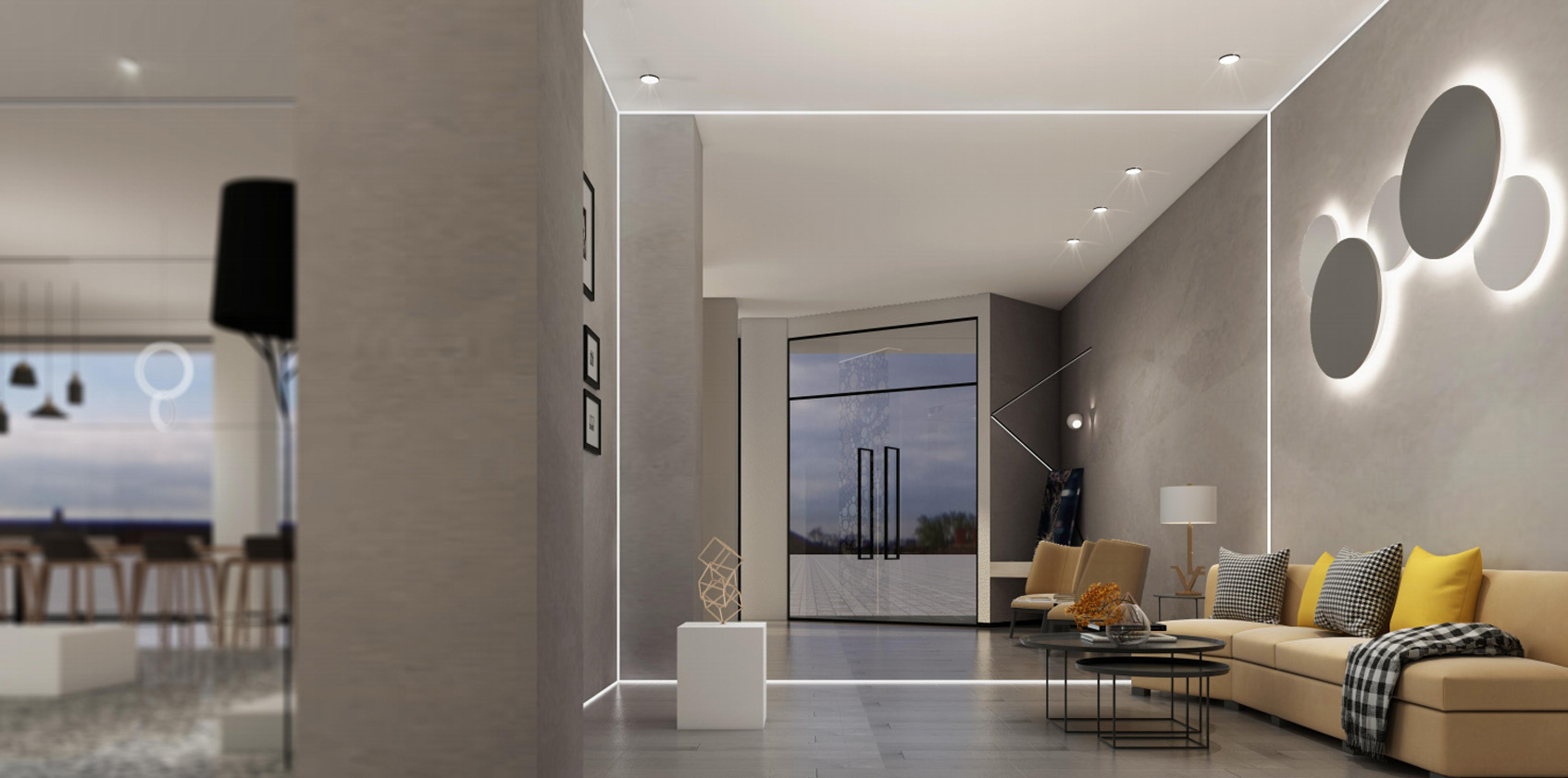
1. Surface lighting. Surface lighting refers to making the indoor ceiling, walls, and floor into luminous surfaces. Ceiling lighting is characterized by uniform illumination and sufficient light, with a wide variety of forms. For example, when fluorescent lamps are used for a suspended ceiling, the light density must be consistent throughout to ensure that every space is adequately illuminated. Another example is a ceiling fitted with a large number of downlights, with regularly arranged bull's-eye lights resembling stars scattered across the night sky. Alternatively, by incorporating the ceiling beam structure, individual light wells can be designed so that light emitted from the wells creates a distinctive spatial effect. Wall lighting is generally used for picture exhibitions. The wall is constructed as a hollow, double-layer partition, with the side facing the display made into a luminous wall containing several glass frames. Floodlighting equipment is installed behind the frames to form a luminous exhibition wall. Large lightbox advertisements also fall into this category of lighting. Floor lighting involves making the floor into a luminous floor, usually for dance floors. Multicolored luminous flooring changes its light and colors in sync with the rhythm of electronic sound, greatly enhancing the artistic atmosphere of stage performances.
2. Strip lighting. Strip lighting refers to arranging light sources in long, linear strips. It can take many forms, including square, grid, linear, rectangular-grid, circular (round or elliptical), triangular, and other polygonal shapes. Examples include perimeter flat strip-lighting ceilings, perimeter recessed strip-lighting ceilings, inner-frame strip-lighting ceilings, inner-frame recessed strip-lighting ceilings, perimeter strip-lighting floors, inner-frame strip-lighting floors, circular strip-lighting floors, uplighting coves, recessed ceiling light coves, and recessed skirting light coves. Linear light strips have a certain guiding function and are often used as guide lighting in the environmental design of public spaces with heavy pedestrian traffic. Other geometrically shaped light strips are generally used for decorative purposes.
3. Point lighting. Point lighting refers to a light source with a small and concentrated illumination range. Because it provides strong illumination, it is mostly used for direct or accent lighting in restaurants, bedrooms, studies, shop windows, stages, and other spaces. Point-lighting techniques come in many forms, including top lighting, bottom lighting, front lighting, backlighting, and side lighting. Top lighting is illumination from above downward, similar to direct sunlight at noon in summer. The illuminated object has a small projected shadow and strong contrast between light and dark, so it is not suitable for use as modeling light. Bottom lighting is illumination from below upward and is suitable for use as supplementary lighting.
4. Front lighting is illumination from directly in front. The shadow is flat, and the colors of the illuminated object are fully revealed, but the sense of depth is weak. Backlighting is illumination from directly behind. It clearly outlines the illuminated object and creates an artistically appealing silhouette effect, making it a commonly used lighting method in photography and for stage backdrops.
5. Side lighting is illumination from the left and right, upper-left, upper-right, lower-left, and lower-right directions. It produces clearly defined shadows, a strong sense of depth, and rich gradation, making it the lighting method most readily accepted by people.
Stationary lighting and moving lighting. Stationary lighting refers to lighting in which the fixtures remain fixed, the illumination remains unchanged, and no flickering occurs. The vast majority of indoor lighting uses stationary lighting. This lighting method makes full use of light energy and creates a stable, soft, and harmonious lighting environment. It is suitable for schools, factories, office buildings, shopping malls, exhibitions, and other spaces.